Instant digital delivery. One purchase, one file, no subscription. Full refund within 14 days if it does not do what this page says it does.
This is a plumbing dispatch spreadsheet that replaces software costing $499 a month. 5 tabs, built for plumbing contractors who are past the whiteboard and not willing to pay per seat for the privilege.
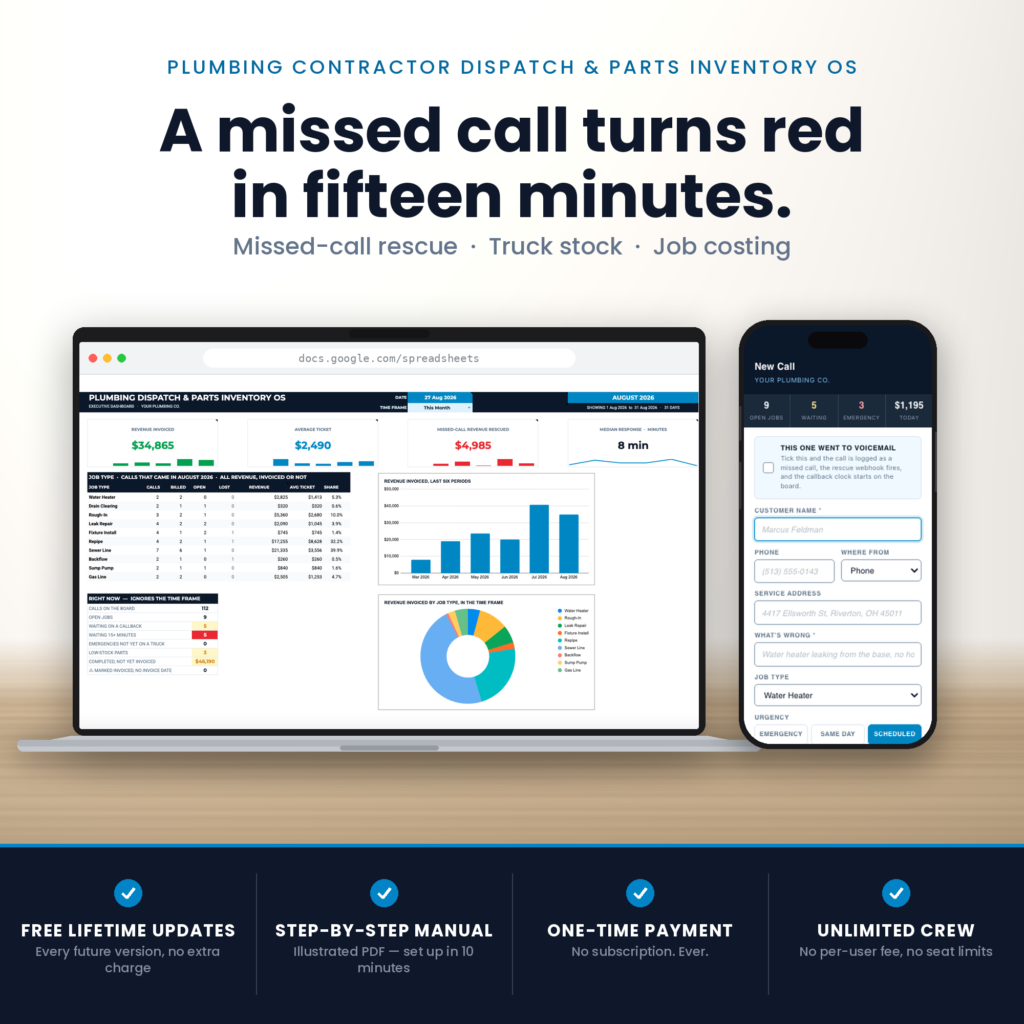
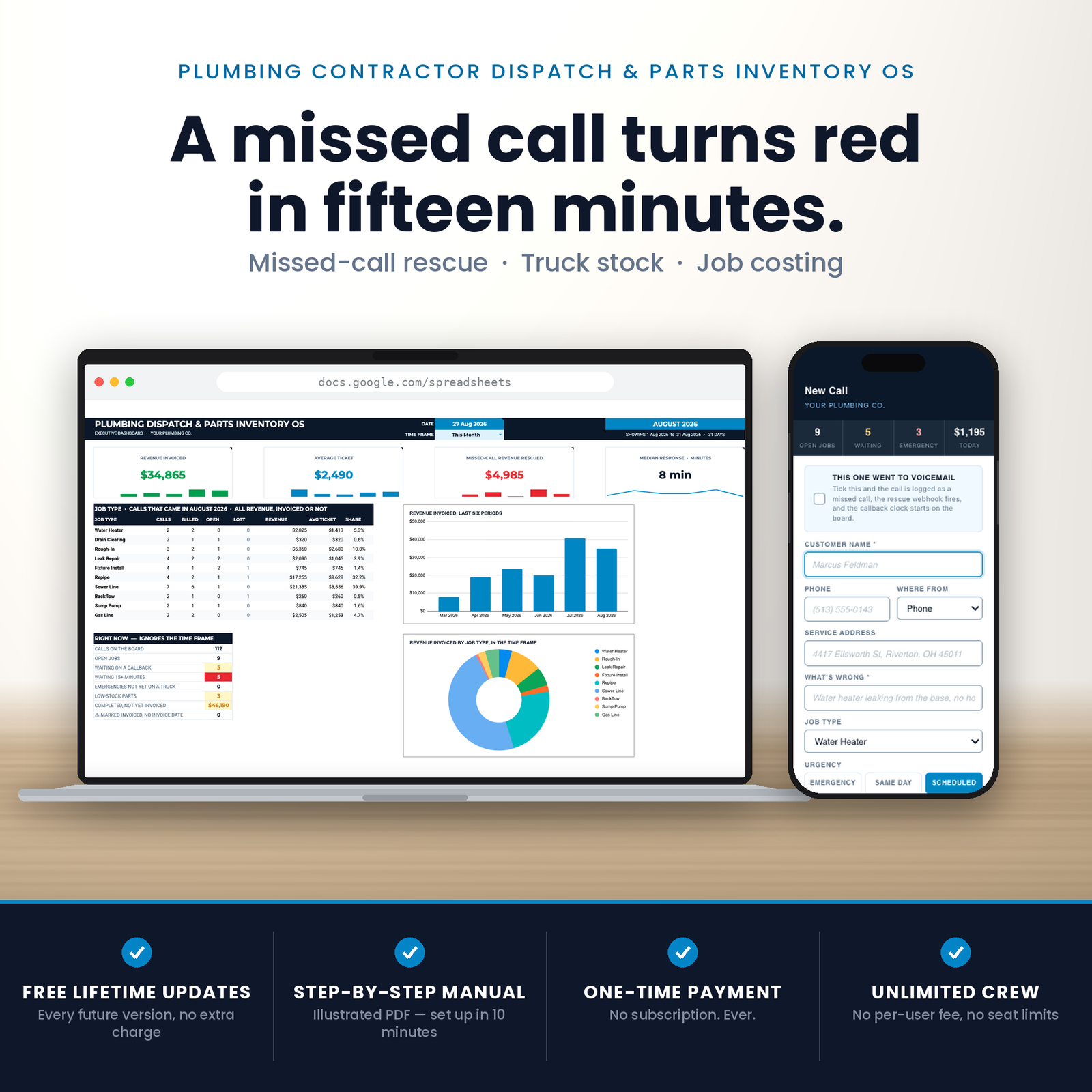
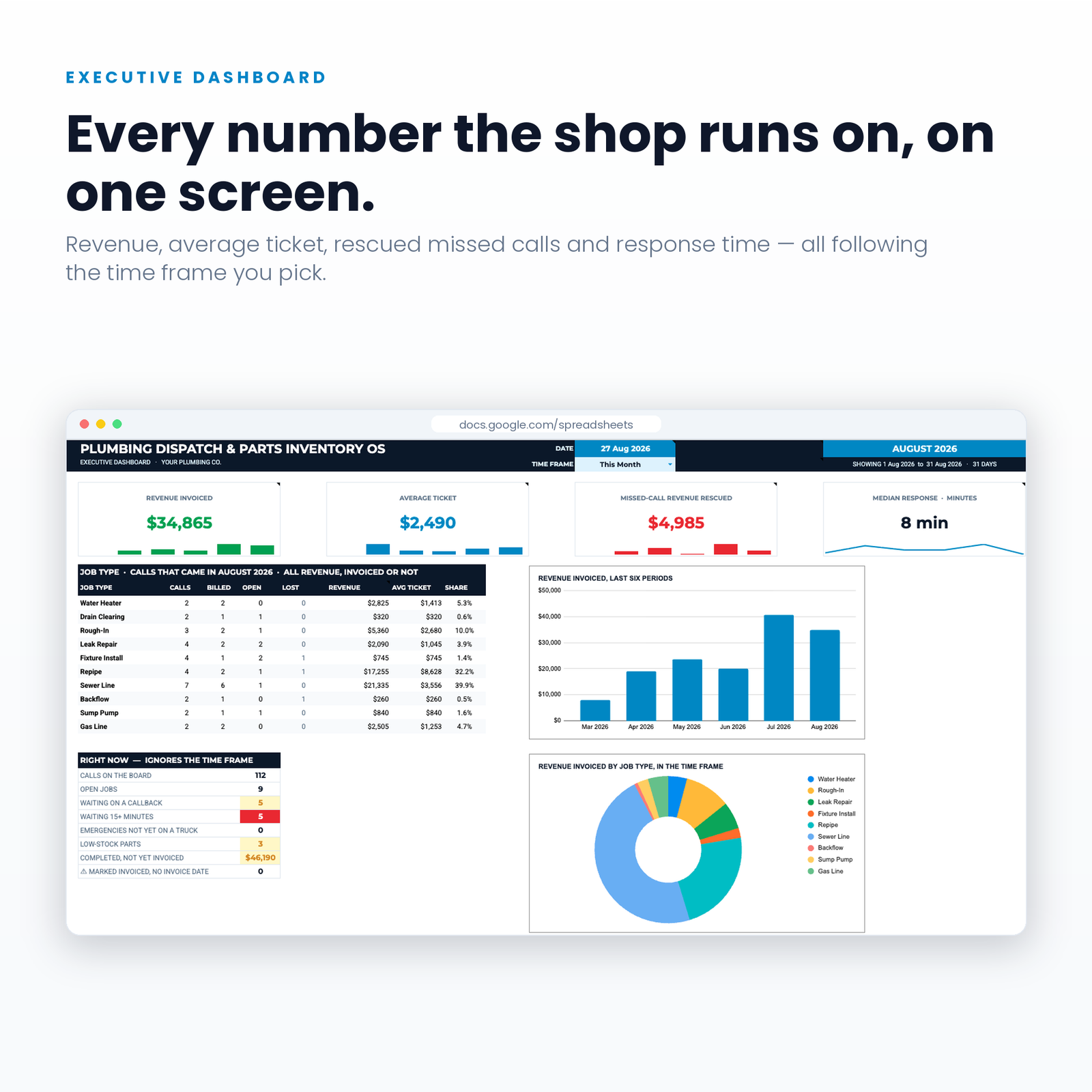
Five tabs and roughly 3,900 formulas, built by a script in one run. A dispatch board with a live callback clock, a tech ticket that pulls parts off the right van, warehouse and three-truck inventory, subcontractor payouts, job costing to the cent, and a dashboard over the top.
It runs in your own Google account. No seats, no per-truck fee, and your customer list is not sitting on somebody else’s server waiting for a pricing change.
Every plumbing shop loses the same money twice, and never sees either half.
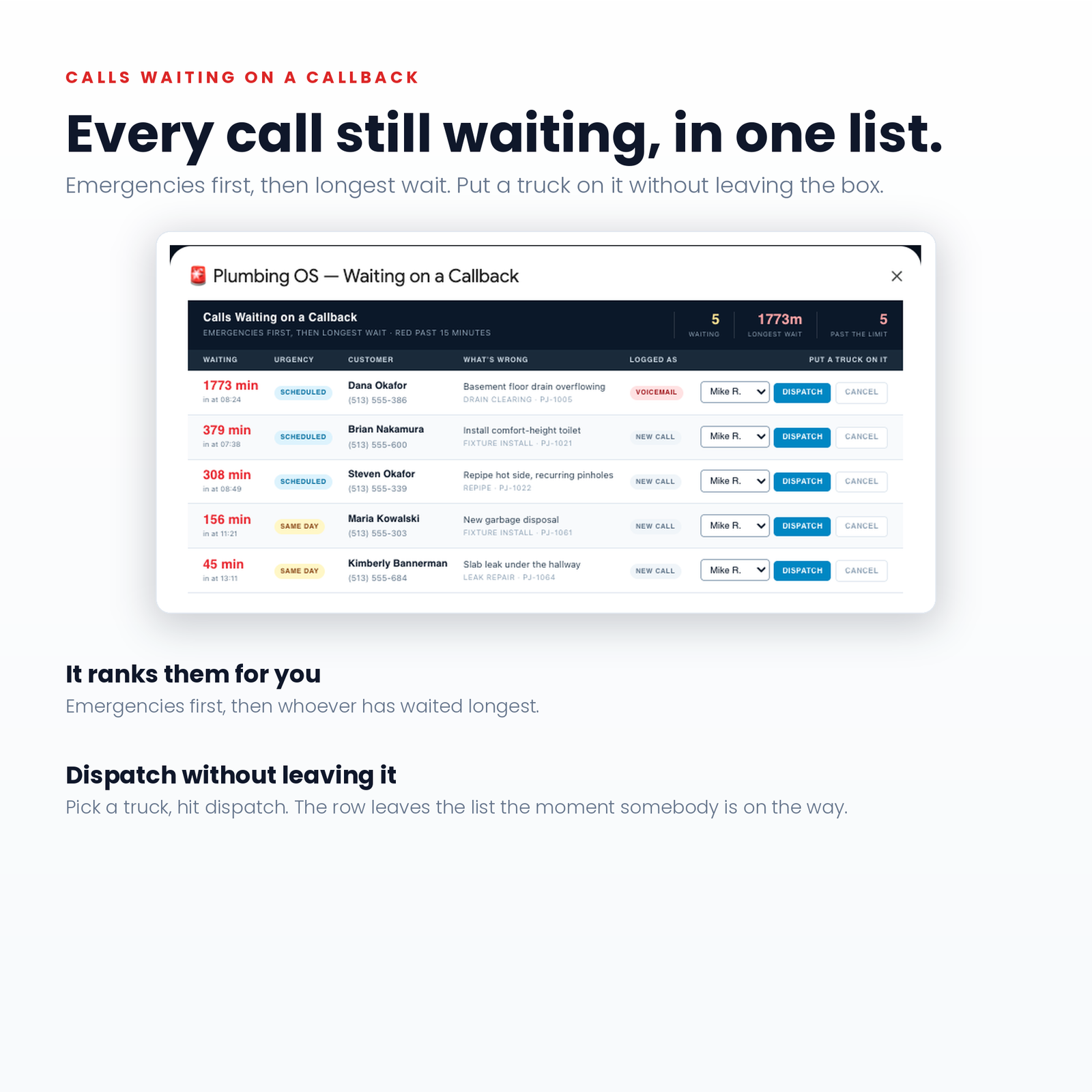
The first half goes to voicemail. Somebody rings at 4:50pm with water coming through a ceiling, nobody picks up, and by six they have called two more plumbers. That call was worth eight hundred dollars and it never appears in any report, because a job that never got logged cannot show up as a loss.
The second half goes on the job itself. The tech spends six hours, pulls a water heater and two fittings off the van, brings in a hydro-jetting sub for an afternoon, and the invoice goes out at a number somebody picked. Whether it made money is a question nobody asks, because answering it means adding up four things that live in four places.
Neither problem is discipline. Both are arithmetic that nobody has time to do standing in a wet basement.
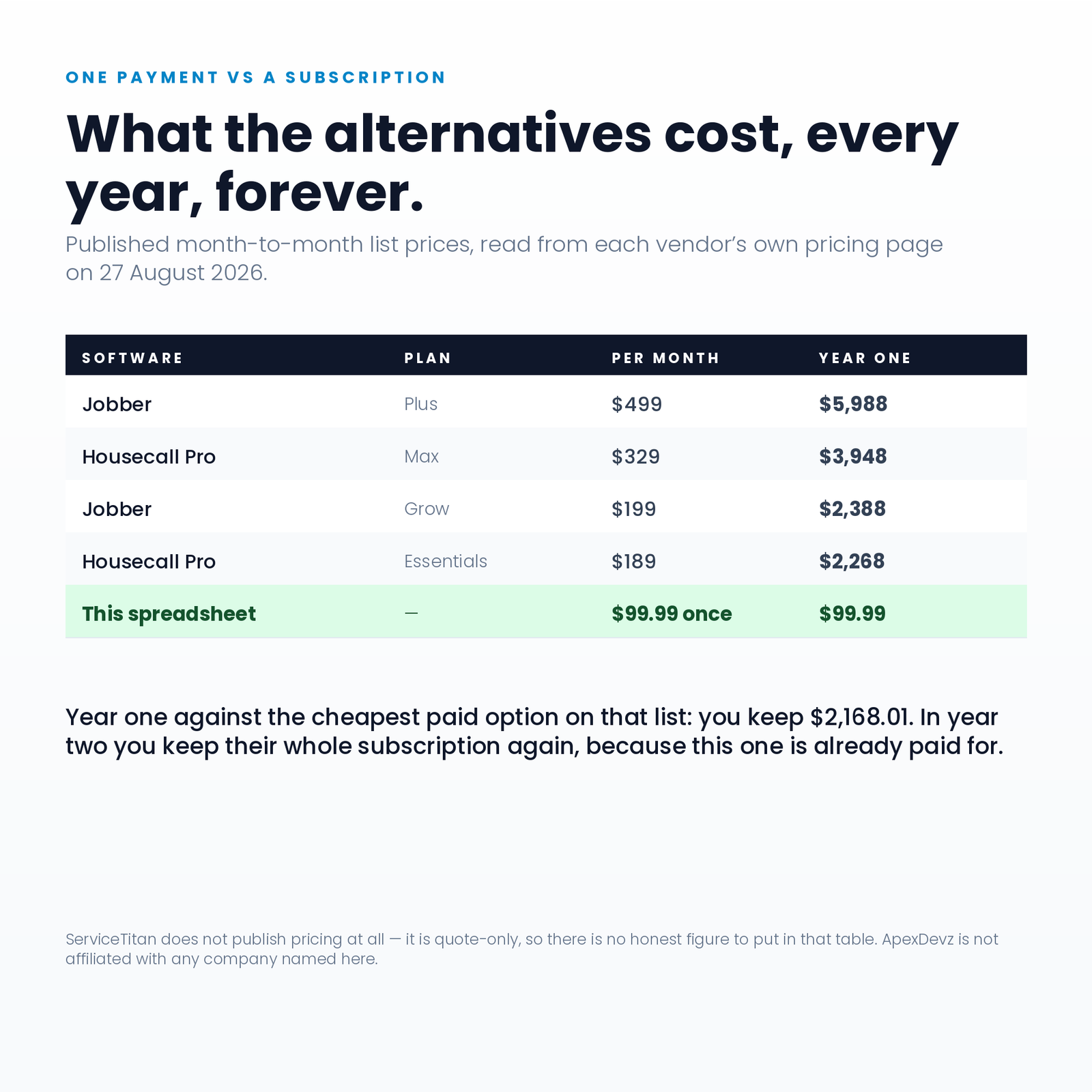
Published list prices, read from each vendor’s own pricing page on 27 August 2026. Month-to-month rates, because that is what you pay in month one — several of these vendors default their own pricing toggle to the cheaper annual-billed figure.
| Software | Plan | Per month | Year one | Seats |
|---|---|---|---|---|
| Jobber | Plus | $499 | $5,988 | 5 users, +$29/mo each |
| Housecall Pro | Max | $329 | $3,948 | 8 users, +$75/mo each |
| Jobber | Grow | $199 | $2,388 | 1 user, +$29/mo each |
| Housecall Pro | Essentials | $189 | $2,268 | 5 users, +$100/mo each |
| This spreadsheet | — | $99.99 once | $99.99 | Unlimited |
ServiceTitan does not publish pricing at all — it is quote-only, so there is no honest figure to put in that table. Its tiers are listed without numbers on its own site.
Year one on the cheapest paid option in that table is $2,268. This is $99.99, once. In year two the difference is the whole subscription again.
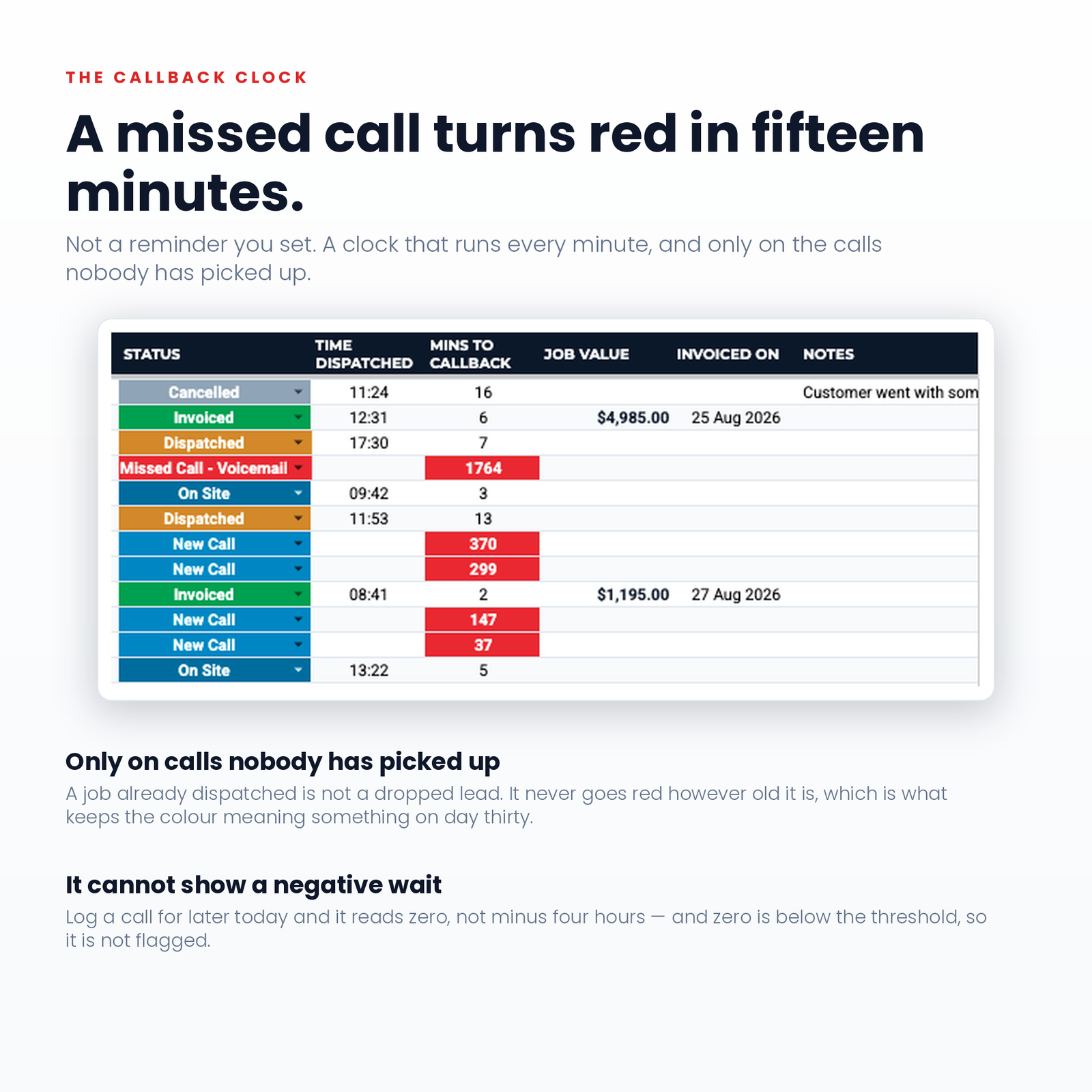
Amber at five minutes, bright red at fifteen — and only on calls still waiting, so a job already dispatched never goes red however old it is. It runs off a trigger every minute, not off a reminder you remembered to set.
Log a call as voicemail and the sheet tracks what you eventually billed for it. Nothing else in this trade puts a dollar figure on the calls you nearly lost.
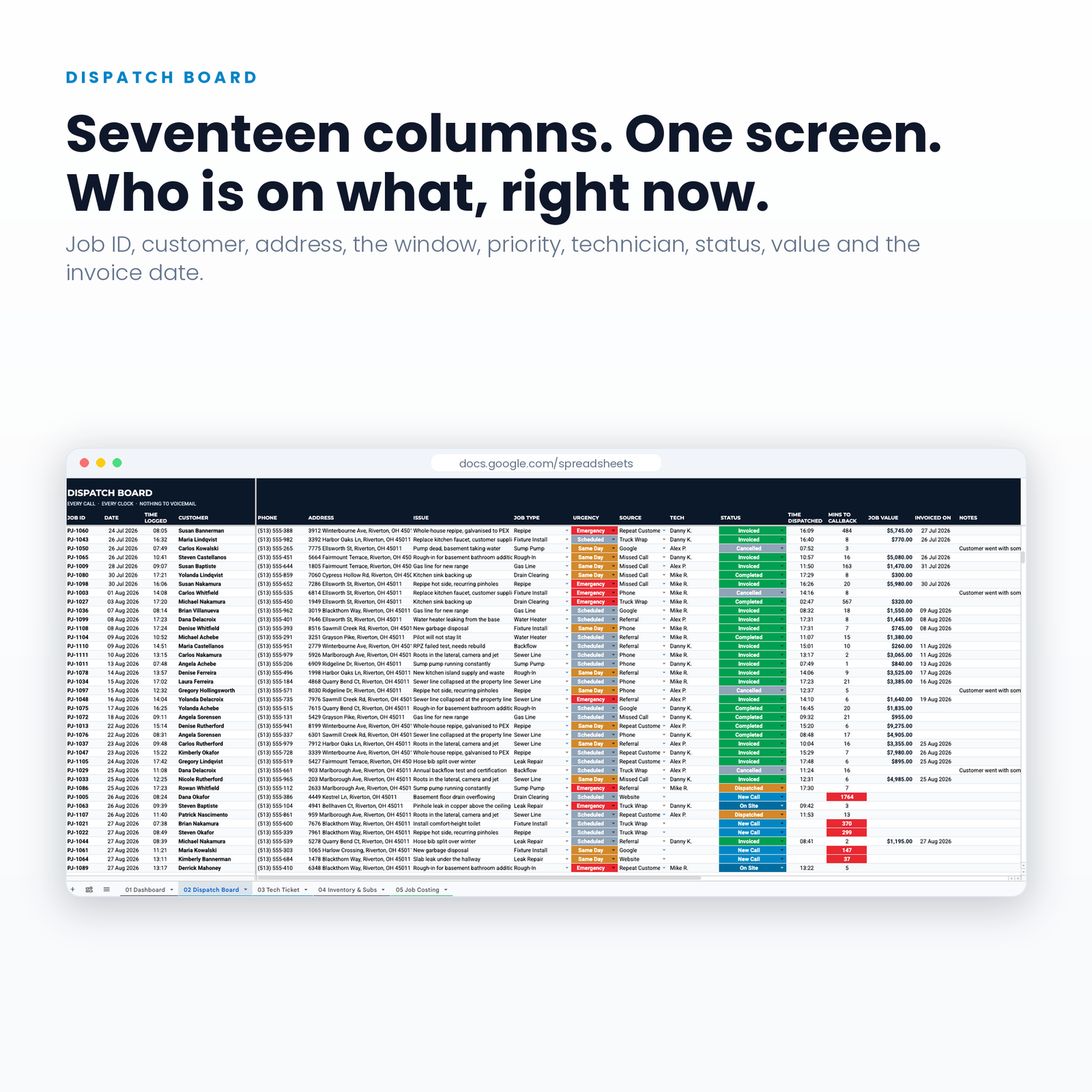
Job ID, customer, address, the two-hour window, priority, technician, status, value and the invoice date. Emergency calls tint the whole row. One screen that answers who is on what, right now.
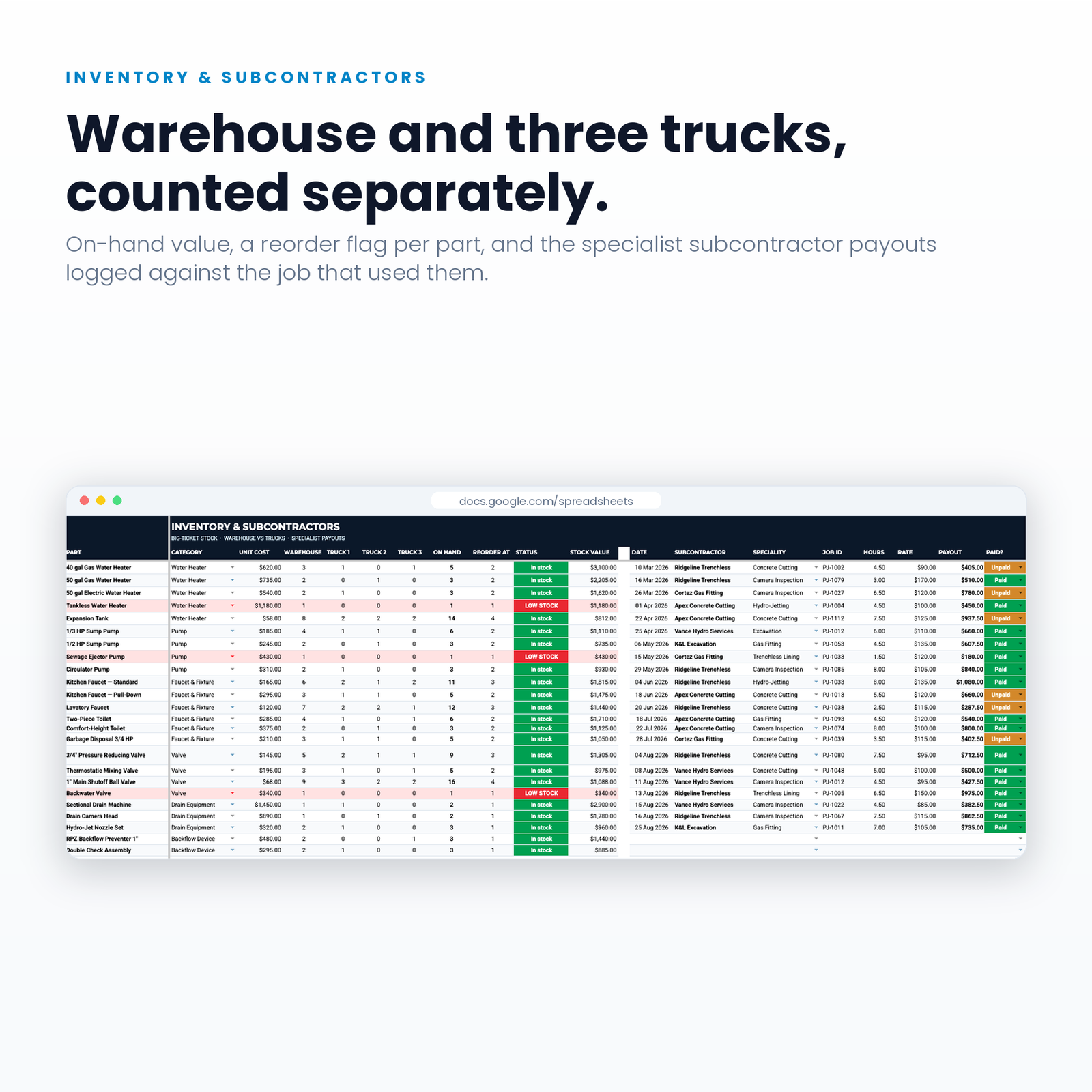
Warehouse plus three trucks tracked separately, with a reorder flag per part. Core parts used on a job leave that technician’s stock the moment you build the invoice — one menu item, no double entry.
Hydro-jetting, camera inspection, excavation, trenchless lining, gas fitting. Hours, rate, payout and whether you have paid them — beside the job ID, so a sub never lands in the wrong month.
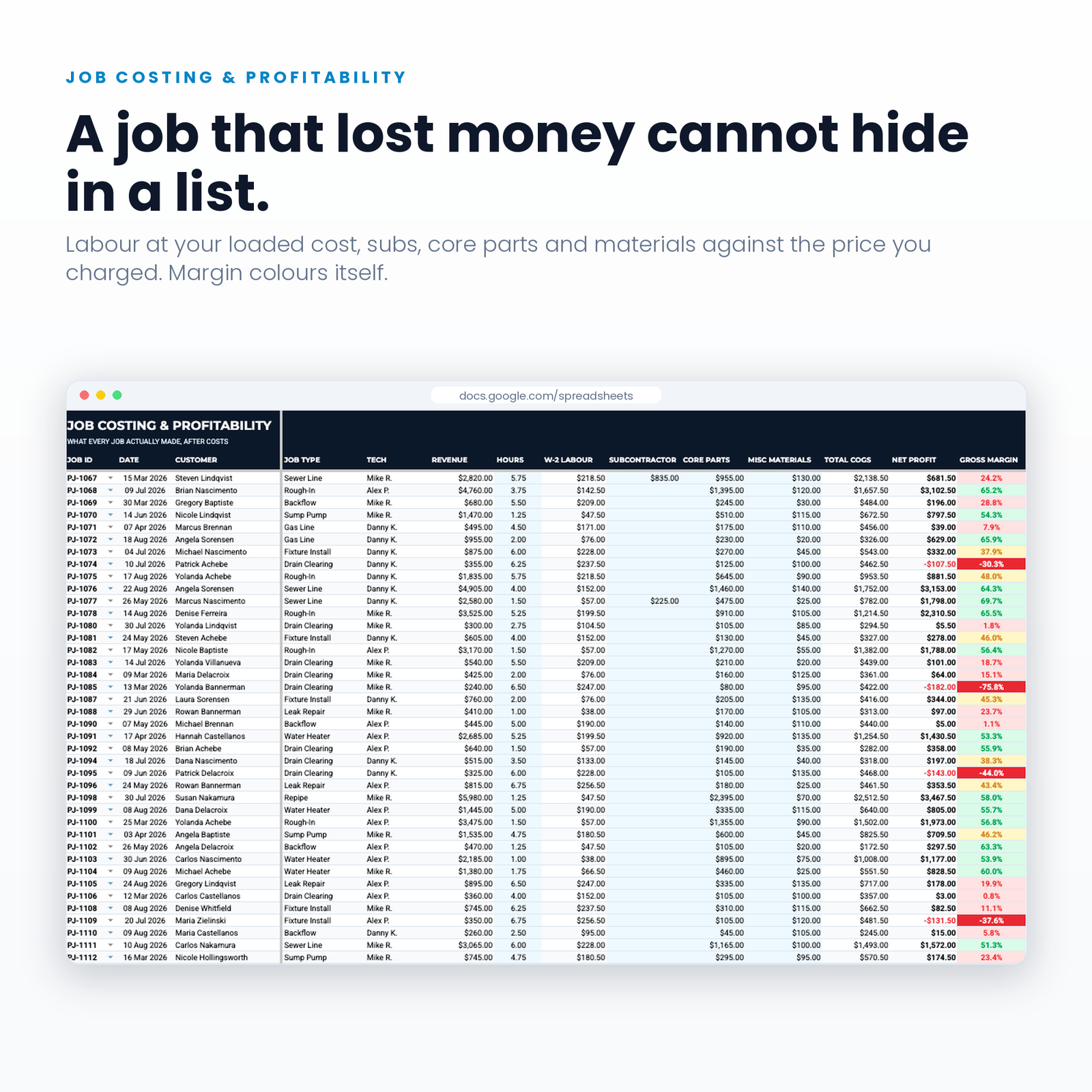
Labour at your loaded cost, subs, core parts and a materials bucket against the price you charged. Margin turns green above 50% and red when the price is below what the job cost you to deliver, before you send it.
PlumbingOS_Setup_Manual.pdf) with the link that copies the sheet into your own Google account.There is no account to create and nothing to install. The whole setup is three steps and about ten minutes.
It ships with 112 demo calls across a season, with parts stock and subcontractor payouts, so every button and every report can be tried before a single real job goes in. One menu item erases it.
It is built for an owner-operator or a small shop — roughly one to eight crews — who has outgrown a notebook, does not want a per-seat subscription, and is comfortable typing into a spreadsheet.
It is not for you if you need a mobile app your crews log into, live GPS tracking, integrated card payments, or a platform that files your paperwork for you. Those are real needs and this does not meet them. If that is your shopping list, buy the subscription — it will be cheaper than buying this and then buying that anyway.
No, and I would rather say so on the listing than in a refund email. It runs on Google Apps Script. You need a free Google account. It will not work in Excel, Numbers or LibreOffice.
No. It logs the call, starts the clock and tells you who is still waiting. Every missed call can fire a webhook to Zapier or Make if you want an SMS to go out on the other end, but that part is yours to build.
Then you already have a dispatch board, and this will not replace a crew app or card processing. What it does that a subscription rarely does is show you the money you never billed — the completed jobs with no invoice raised, and the revenue you got back off voicemail.
It is one file. Share it with all four. There is no seat count, and there never will be, because you are buying a file rather than access to a service.
Same engine, different trade — all in Industry Dashboards:
New here? The setup walkthrough shows what the first ten minutes look like, and the rest of the catalogue covers the other trades. Our refund policy is 14 days. If you have never copied a shared sheet before, Google explains how to make a copy of a file.
One purchase, one spreadsheet in your own Drive. No subscription, no account to keep, no monthly fee.
Copy the file, reload it once, run a single menu command. Nothing to configure and no setup wizard.
Every figure that changes your plan shows how it got there, in the sheet, before anything is rewritten.
The script reads and edits that one spreadsheet. No email, no other Drive files, and nothing is collected by us.
Google Sheets only. Excel cannot run the automation. Menu commands need a desktop browser, and day to day use works on mobile.
Immediately, as a link to the workbook and a setup manual. You copy the file into your own Google Drive and it is yours from that point.
No. The automation is Google Apps Script, which only runs inside Google Sheets. Opening the file in Excel gives you a spreadsheet with no menu and formulas that will not resolve.
Reload the file first, because the menu only appears after the first reload. If that does not fix it, support goes to a person and you get a reply rather than a ticket number.
Within 14 days, if the workbook will not build or does not do what this page says it does. The one exclusion is buying it for Excel, which is stated here, in the terms, and on How it works.